
In today's hyper-competitive digital economy, software is the lifeblood of nearly every business. From mission-critical enterprise applications to customer-facing mobile apps, the ability to rapidly develop, deploy, and scale technology is the primary driver of market leadership. However, for many U.S. business owners, building an in-house software development team is a significant and often prohibitive challenge. The scarcity of top-tier talent, coupled with soaring domestic salaries, has made the traditional hiring model a costly and slow-moving process. This is where offshore software development emerges not just as a viable alternative, but as a strategic imperative. This comprehensive, long-form guide will take you on a journey to understand the profound benefits and use-cases of leveraging global talent pools for your software development needs. We will move beyond the superficial discussion of "cost savings" and delve into the multi-dimensional advantages that can transform your business, accelerate your time-to-market, and position you for sustained growth. While often oversimplified, the financial benefits of offshore outsourcing are profound and multi-faceted. It's not just about lower salaries; it's about eliminating significant overhead costs and optimizing your business's capital expenditure. The decision to look beyond domestic borders for talent is a direct response to a fundamental shift in the U.S. economy. It is a strategic move driven by market realities, not just a desire for lower costs. This section establishes the foundational context for why offshore hiring has become an essential component of a modern business strategy.
Moving Beyond Simple Cost Reduction
While cost reduction is a significant factor—cited as a primary reason by 57% of companies—a more detailed analysis shows that the true value of offshore hiring lies in a constellation of strategic benefits. These drivers elevate the practice from a cost-saving tactic to a core component of a company's growth strategy.
Access to a Global Pool of Specialized Talent: Offshore outsourcing provides immediate access to professionals with a diverse range of skills that may be difficult to find locally. The global market is rich with specialized expertise. For example, Eastern Europe has become a hub for AI and Machine Learning engineers, while Latin American countries offer a robust pool of bilingual professionals for customer support and other roles. This allows a business to acquire niche capabilities without being limited by geographic constraints.
Accelerating Time-to-Market and Enhancing Scalability: Outsourcing enables companies to scale their operations quickly to meet fluctuating market demands or to accelerate product launches. This is particularly valuable for startups and small-to-medium businesses (SMBs) that need to remain agile to compete with larger enterprises. By leveraging a scalable, external workforce, a company can handle seasonal demand spikes and launch products three times faster than competitors.
Strategic Focus on Core Competencies: One of the most critical benefits of offshore hiring is the ability to reallocate internal resources to high-value activities. By outsourcing non-core, repetitive functions such as accounting, IT help desks, or payroll, a business can empower its in-house team to concentrate on its primary mission and competitive advantage. This is a strategic re-prioritization that elevates the entire organization.
Achieving 24/7 Operations and Competitive Advantage: Hiring teams across different time zones ensures a company can maintain continuous operations. This is a significant competitive advantage, especially for customer service, technical support, and development teams that need to work around the clock to meet global demand and resolve issues quickly.
The capital liberated by lower labor costs is not the final outcome of a successful offshore strategy; it is the means to a greater end. The financial savings, which can be as high as a 70% reduction in developer salaries compared to the U.S. , provide a valuable pool of capital. This freed-up capital can be reinvested into innovation, research and development (R&D), marketing initiatives, or other core business functions that directly contribute to top-line growth. The success stories, such as Citigroup saving over $1 billion annually , are not simply about the money saved; they are about what that money enabled, demonstrating a higher return on investment (ROI) that goes far beyond a reduced bottom line.
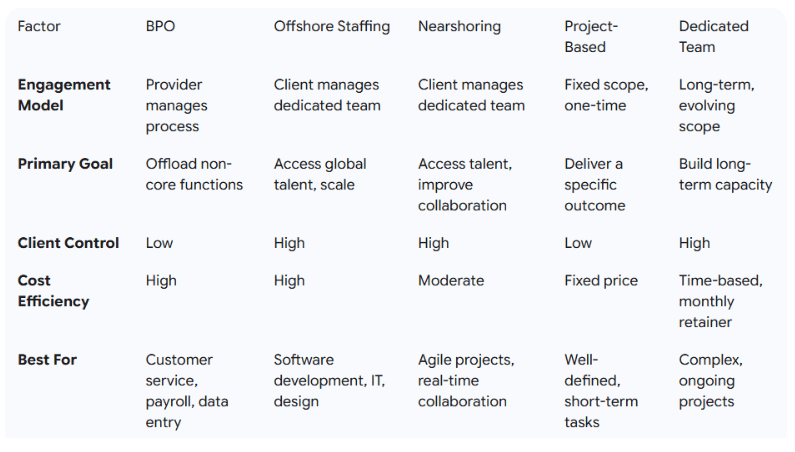
Choosing the right offshore hiring model is a critical decision that depends on a company's specific goals, the nature of the work, and the desired level of control. The landscape is not a monolith; it is a spectrum of options, each with distinct advantages and trade-offs. Two prominent models dominate the outsourcing landscape: Business Process Outsourcing (BPO) and offshore staffing. While both involve remote work, they represent fundamentally different engagement models and levels of client involvement.
Business Process Outsourcing (BPO): This model involves contracting out specific, non-core business functions—such as customer support, accounting, or data entry—to an external service provider. The BPO provider assumes responsibility for managing and executing the entire process, leveraging their economies of scale and specialized expertise. The client's involvement is often limited to a high-level oversight, with minimal direct control over the day-to-day operations. This model is ideal for repetitive, well-defined tasks where the primary goal is efficiency and offloading a function to a specialist.
Offshore Staffing: This approach entails hiring a skilled professional or a dedicated team from an overseas location to work exclusively for the client. The offshore staff operates as a direct extension of the in-house team, with the client maintaining full control over project management, workflows, and communication. This model is best suited for roles that require deep integration, specialized skills, and a high degree of collaboration, such as software development or creative work.
The choice between BPO and offshore staffing represents a trade-off between convenience and control. BPO offers the convenience of a "set it and forget it" solution for standardized processes, while offshore staffing provides the flexibility and control to manage a team that is deeply integrated into the company’s culture and projects. A business owner must assess which of these is more valuable for a given function, recognizing that a project requiring deep collaboration may be better suited for a dedicated team, while a repetitive back-office task is a prime candidate for BPO. Beyond the engagement model, the geographic location of the offshore partner introduces a different set of factors, including time zone alignment, cultural compatibility, and cost.
Offshoring: This practice involves partnering with providers in distant countries, often in Asia or Eastern Europe. The primary advantage is the dramatic cost reduction due to lower labor costs and overhead. However, this model can present challenges related to significant time zone differences, which can delay communication and decision-making, as well as cultural and language nuances that require careful management.
Nearshoring: This involves outsourcing to a country in a geographically proximate region, such as a U.S. company hiring in Mexico or Colombia. The benefits include a closer time zone alignment, which allows for real-time collaboration and easier scheduling of meetings, as well as stronger cultural and linguistic compatibility. While nearshoring may not offer the extreme cost savings of offshoring, it provides a valuable balance between cost efficiency and operational logistics.
The decision is not always a binary choice. The concept of "hidden costs"—such as time delays, rework due to miscommunication, and project management overhead—can significantly erode the initial cost savings of pure offshoring. For projects that require tight feedback loops, agile workflows, and consistent daily synchronization, the higher cost of a nearshore team can be a more valuable investment because it increases the speed and quality of delivery. This re-frames the decision from a simple cost analysis to one that considers the value of velocity and the total cost of a project, including time and communication overhead. The most sophisticated companies often adopt a
hybrid model, strategically blending onshore, nearshore, and offshore teams to optimize for cost, quality, and risk across different functions.
Dedicated Teams vs. Project-Based Outsourcing
The duration and scope of an engagement also define the hiring model, offering a path for businesses to transition from short-term experiments to long-term strategic partnerships.
Dedicated Teams: This long-term model involves a team of remote experts who work solely on the client's projects. The client retains full control and flexibility, allowing the team to adapt to evolving project needs and scale as the business grows. This is the ideal model for ongoing, complex, or scaling projects that require deep institutional knowledge and continuous collaboration.
Project-Based Outsourcing: This is a short-to-medium-term engagement with a fixed scope and a predefined budget. It is best suited for one-time, well-defined projects with clear objectives and deadlines. The outsourcing vendor is responsible for delivering the project from beginning to end, with minimal client involvement.
The transition from a short-term, project-based engagement to a long-term, dedicated team relationship mirrors a business’s journey from a tactical, transactional approach to a strategic partnership. A business owner can use the project-based model as a low-risk way to test the waters of offshore hiring and to prove the ROI on a well-defined task. A successful outcome builds the trust and confidence needed to justify a more significant, long-term investment in a dedicated team, thereby supporting long-term growth and seamless scalability. This table provides a concise, comparative overview of the different models, serving as a quick reference guide for a business owner evaluating their options.
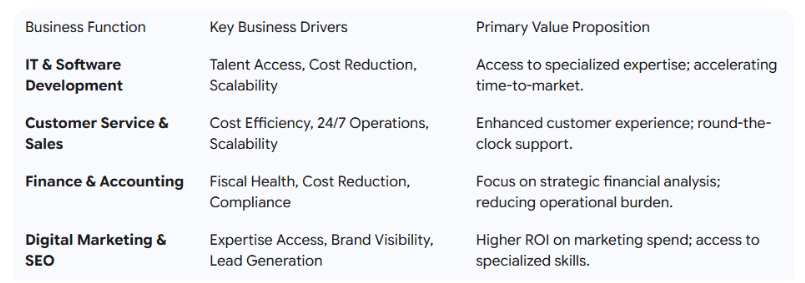
While any business process can theoretically be outsourced, some functions have proven to be exceptionally successful candidates for offshore hiring due to their nature and the market's demands. This section explores these high-impact use cases, providing concrete examples of how they work in practice.
IT and Software Development: The Digital Backbone
The technology sector is the single largest driver of offshore outsourcing. Companies are outsourcing a wide range of IT functions, from routine help desk support to complex software development and cybersecurity. The demand for these services is surging as businesses undergo digital transformation and face a critical domestic talent gap.
Services within this category include:
Software and Application Development: Approximately 79% of companies use external providers for software development.
IT Infrastructure Services: Around 77% of firms outsource IT infrastructure, ensuring a robust and reliable digital environment.
Cybersecurity: Given the escalating threat of cybercrime—projected to cost $10.5 trillion annually by 2025—cybersecurity has become a top priority for outsourcing. Over 81% of companies leverage external providers for these services.
The relationship between an outsourced IT team and an in-house team is not competitive but rather symbiotic. By outsourcing routine tasks like IT help desk support, a company can free its internal, high-value tech talent to focus on core innovation and strategic projects that generate revenue and drive the business forward. This approach transforms the in-house team into a strategic force, proving that outsourcing can be a key component of an internal talent strategy, acting as a "force multiplier" for existing resources.
Customer Service & Sales: The Frontline of Business Growth
Customer service and sales functions remain a top candidate for outsourcing, primarily due to their labor-intensive nature and the necessity of providing 24/7 support. Offshore call centers, particularly in locations like the Philippines, provide access to a highly skilled, English-speaking workforce at a fraction of the cost of local hires. The strategic adoption of outsourcing in this area is moving beyond simple cost reduction. With the increasing integration of AI-powered chatbots and virtual agents handling up to 80% of routine customer queries, human agents are freed to focus on complex, high-value problem-solving and customer relationship management. A modern outsourcing strategy can therefore enhance the customer experience, not just maintain it. It allows a business owner to build a more responsive and efficient support system by leveraging the best of both human and technological resources, ensuring a higher quality of service for complex issues while maintaining efficiency for routine inquiries.
Finance & Accounting: Ensuring Fiscal Health and Compliance
The outsourcing of accounting and finance functions is growing rapidly, as maintaining a costly in-house team can be a significant burden for businesses, especially SMBs. Offshore providers handle a full spectrum of services, including bookkeeping, tax preparation, payroll, and financial analysis.
By outsourcing repetitive financial tasks, such as invoicing and expense tracking, a business can empower its internal leadership to shift their focus from paperwork to strategic financial analysis and long-term planning. This is a direct application of the "focus on core competencies" principle. The finance team can evolve from being a simple cost center focused on processing transactions to a strategic partner that provides valuable insights for business growth and decision-making.
Digital Marketing, Email Campaigns & SEO: Driving Brand Growth
Digital marketing and search engine optimization (SEO) are highly specialized skills that require continuous monitoring, technical expertise, and a deep understanding of ever-changing algorithms. Outsourcing these functions provides access to a global pool of experts who can handle keyword research, content strategy, link building, and paid ad campaigns at a competitive cost. The financial benefit here can be multiplicative. The substantial cost savings from hiring a remote marketing team—with roles like SEO specialists, content creators, and social media managers —can be reinvested into a higher ad spend or the production of more high-quality content. This creates a powerful, positive feedback loop: the efficiency gained from a lower-cost offshore team directly improves the performance of other marketing initiatives, generating a higher return on investment (ROI) and a stronger competitive position.
The theories and models of offshore hiring are best understood through the lens of real-world success stories. These case studies demonstrate how some of the world's most successful companies have leveraged global talent to achieve their strategic objectives.
WhatsApp: The launch of WhatsApp is a classic example of using offshoring to focus on core competencies. Before its release in 2009, the company outsourced its software development to a team in Eastern Europe. This strategic move allowed its small, in-house team to focus on the most critical challenge: product vision and customer support. This division of labor enabled a rapid and successful product launch, which ultimately led to its acquisition by Facebook for an astounding $19 billion.
Google: The world's largest search engine demonstrates that offshoring is not just for startups. In 2020, Google acquired CloudSimple, a startup with a software development team in Eastern Europe. This move was driven by a need for specialized expertise to enhance its VMware migration solution, proving that even a company with an enormous in-house talent pool will leverage external resources to acquire niche skills and accelerate innovation.
Slack: Both Slack and Microsoft teams provide compelling examples of using outsourcing for "speed-to-market." In its early stages, Slack outsourced significant portions of its software development to a Canadian firm to expedite its platform launch. Similarly, Skype outsourced its initial software development to a team in Estonia. In both cases, the decision to leverage external expertise allowed them to bring their products to market faster than if they had relied solely on in-house resources, which was a critical factor in their early growth and subsequent success.
Financial Powerhouses: How Citigroup Saved a Billion
The financial services industry, often viewed as highly conservative and regulated, has embraced offshore hiring to great effect. In 2012, Citigroup moved over 11,000 jobs offshore with the explicit goal of reducing costs and reallocating resources toward initiatives with a higher ROI. This strategic initiative resulted in annual savings exceeding $1 billion. The success of this move created a ripple effect, with other major financial institutions, including J.P. Morgan and Bank of America, adopting similar approaches to outsource their IT help desks and other functions. This demonstrates how a successful offshore strategy can become an industry standard, validating its long-term strategic value on a macro level.
Startup Agility: GoTransverse and Wise's Strategic Offshore Play
GoTransverse: This U.S.-based product company provides a powerful case study in rapid scalability. Facing a need to accelerate delivery and increase cost efficiency, GoTransverse built a senior full-stack development team of six in Eastern Europe in just six weeks. This story resonates with business owners who need to scale quickly without the overhead and lengthy recruitment process of local hiring.
Wise: The global money transfer service, Wise, relied on contractors from Ukraine and Estonia in its early days to keep initial expenses to a minimum. With limited capital, the company needed an IT support team that could provide quality service while keeping costs low. This strategic use of offshore talent allowed them to secure the skills they needed to get their platform running and scale without a large initial investment, proving that offshore hiring is a viable strategy for bootstrapped startups focused on capital efficiency.
These case studies collectively demonstrate a critical principle: offshore hiring is a competitive advantage that can be leveraged by any business, regardless of size or industry. For a business owner, this means that the strategic deployment of a global workforce is not just about competing on price; it is about building a more resilient, agile, and efficient organization.
The integration of artificial intelligence (AI) and automation is profoundly reshaping the BPO and outsourcing landscape. AI-powered tools, such as chatbots and virtual agents, can automate a significant percentage of routine customer queries, freeing human agents to focus on complex problem-solving and higher-value tasks. Similarly, Robotic Process Automation (RPA) is streamlining back-office functions like data entry and claims processing, reducing operational costs and time. This trend does not diminish the need for a human workforce. Instead, it creates new, more complex roles for human oversight, training, and strategic problem-solving. The future of outsourcing is a hybrid model where AI and humans collaborate seamlessly. Offshore teams are often at the forefront of this integration, providing the human-in-the-loop oversight and expertise that allows for the successful deployment of intelligent automation. For a business owner, this means that the role of management shifts from overseeing low-level tasks to a higher-level oversight of an intelligent, blended workforce.
Successful transition from a local to a global talent model requires a thoughtful, multi-dimensional approach. It necessitates a clear understanding of the different engagement and geographic models, a robust plan for mitigating risks, and a commitment to building a new kind of business infrastructure. The future of work is global, and the businesses that will thrive are those that embrace this reality. By leveraging a global workforce, U.S. business owners can not only stay competitive but also unlock new levels of innovation and scale, ensuring long-term success in an ever-changing world.