
The landscape of Business Intelligence (BI) is undergoing a profound transformation, driven by accelerating digital initiatives and an exponential surge in data. This report delves into the evolving dynamics of BI, exploring both in-house team structures and the strategic imperatives behind outsourcing key BI roles and functions. The global BI market, valued at over $41 billion in 2024 and projected to reach over $151 billion by 2034, underscores the critical importance of data-driven decision-making for organizational success.
Organizations face a persistent challenge in building and retaining specialized in-house BI talent amidst a significant skills gap, particularly in areas like AI, machine learning, and data engineering. This talent scarcity, coupled with the high costs associated with in-house teams and technology investments, increasingly positions outsourcing as a strategic imperative rather than a mere cost-cutting measure. The analysis reveals that outsourcing BI functions offers substantial benefits, including significant cost efficiencies, access to a global pool of specialized expertise, enhanced scalability, faster implementation of analytics solutions, and the ability to leverage advanced technologies like AI and cloud-native platforms without heavy upfront investment.
The report examines various BI team structures—centralized, decentralized, and hybrid—highlighting their respective strengths and weaknesses. While centralized models offer control and standardization, and decentralized models provide local agility, hybrid models are emerging as the preferred approach for mature organizations, balancing agility with strategic oversight. This balance is crucial for effective BI, necessitating robust communication protocols, clear performance metrics, and stringent data security and compliance frameworks in any outsourced partnership.
Quantifiable success stories across diverse industries, from e-commerce and healthcare to manufacturing and financial services, demonstrate tangible returns on investment (ROI) from BI outsourcing. These examples showcase not only cost reductions but also improvements in operational efficiency, enhanced data accuracy, accelerated time-to-market, and improved customer satisfaction. Ultimately, strategic outsourcing in BI enables businesses to focus on core competencies, mitigate risks, and gain a competitive advantage in a data-saturated world.
Decentralized BI Models: Strengths, Weaknesses, and Ideal Applications
In a decentralized Business Intelligence (BI) model, analytics and data science resources are distributed across various departments or business units within an organization. Each of these teams operates largely independently, without a formal overarching coordination mechanism. This structural choice emphasizes local autonomy and responsiveness, allowing individual units to tailor their BI efforts directly to their specific operational needs.
The primary strengths of a decentralized model stem from its close proximity to the business functions it supports. This alignment ensures a high degree of responsiveness and dedicated analytical support for the immediate needs of each unit. Business units gain significant flexibility, as they can establish their own analytics teams independently, without needing permission or alignment from other parts of the company. This minimizes bureaucratic hurdles and allows for rapid initiation of standalone BI programs. The direct involvement of analysts with business problems often leads to a deeper understanding of operational nuances and quicker implementation of solutions that directly address local pain points.
However, the decentralized model is fraught with significant weaknesses that can undermine enterprise-wide BI effectiveness. A major drawback is the inherent lack of mechanisms to support corporate or cross-unit requirements, which severely limits the realization of initiatives that could be valuable to the entire company. This often leads to considerable redundancy, as individual teams make their own investments in tools and solutions, duplicating costs and efforts across the organization. Solutions developed by one team might remain unknown or inaccessible to others, preventing knowledge sharing and best practice adoption. There is also a strong potential for divergence in tools, methodologies, and strategies across different teams, which can negatively impact overall effectiveness and create inconsistencies in data interpretation and reporting at the enterprise level. Furthermore, team members within decentralized structures may experience hindered career advancement. They are often confined to their small, siloed teams and lack the internal resources for collaboration or learning from other departments, which can limit their professional growth and retention. The primary benefit of "proximity to business function" directly addresses the responsiveness issues of a centralized model. However, the inherent "lack of corporate support," "redundancy," and "divergence" indicate that while individual business units might achieve local optimization, the organization as a whole misses out on economies of scale, shared best practices, and a unified view of data. This model essentially trades enterprise efficiency and strategic alignment for localized autonomy, which is often unsustainable for comprehensive BI initiatives.
Despite these considerable limitations, a decentralized model can be suitable in specific contexts. It is often appropriate for companies in the initial stages of their analytical journey, allowing a few business units to independently demonstrate the value of analytics without significant central investment or coordination. This can help lay the groundwork for transitioning to a more structured model once a clear strategy is developed and value is proven. It is also well-suited for parent companies that own multiple distinct subsidiaries, where each subsidiary operates independently and has unique business needs and objectives. In such scenarios, even if a centralized team exists within the parent company, its scope is typically limited, and subsidiaries largely operate autonomously, aligning with their distinct requirements. However, for typical organizations, a purely decentralized model is generally not considered an effective long-term solution for comprehensive and scalable BI initiatives.
Hybrid BI Models: Strengths, Weaknesses, and Ideal Applications
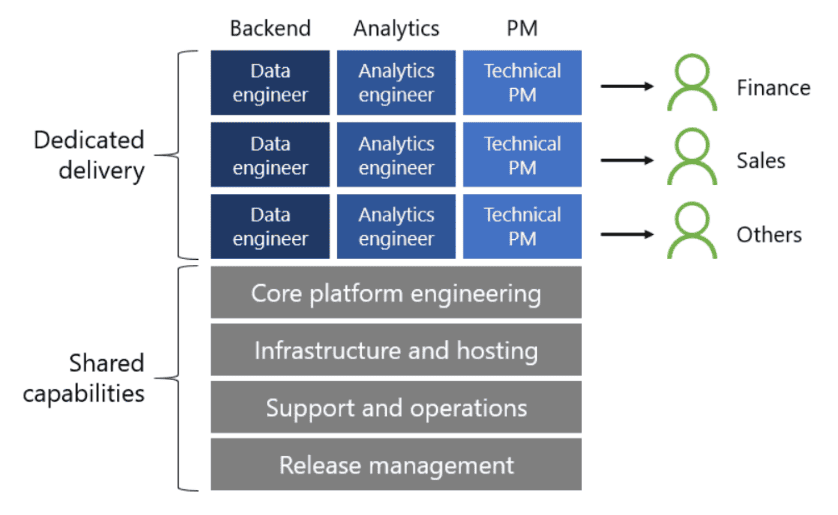
The hybrid Business Intelligence (BI) model represents a sophisticated and increasingly favored approach that strategically combines elements of both centralized and decentralized structures. In this model, analytics and data science teams are distributed across various business units or functions within an organization, while a central, corporate team is simultaneously maintained to provide strategic direction, standardization, and overarching support. This central team can operate with direct authority over the distributed teams or function as a peer, fostering collaboration and alignment.
This model is recognized as an evolutionary apex for enterprise BI structures, as mature and successful analytics organizations frequently adopt some form of a hybrid model after experiencing the limitations of purely centralized or decentralized approaches. The hybrid approach aims to capture the best of both worlds: the agility and business proximity characteristic of decentralization, coupled with the governance, standardization, and strategic alignment offered by centralization.
The strengths of a hybrid model are multifaceted. It effectively facilitates both innovation and scalability. Centralized Centers of Excellence (COEs) within this model can explore new analytical areas and then efficiently disseminate that knowledge broadly across the organization, promoting consistent innovation. The central team plays a crucial role in enabling the pursuit of corporate projects that span multiple business units, ensuring enterprise-wide strategic alignment. This model also ensures that corporate standards for tools and platforms are maintained consistently, and it provides necessary training and support to all analytical personnel. Furthermore, it enhances employee mobility across different teams, which significantly contributes to career development and job satisfaction, ultimately aiding in talent retention. The growth inherent in a hybrid organizational structure also leads to the creation of more senior roles, further benefiting career progression.
Despite its numerous advantages, the hybrid model is not without its weaknesses. In pure COE models, the COEs may sometimes lack formal power and must rely heavily on relationships and influence to achieve their goals, which can be a limitation. In federated models, decision-making can be challenging due to the absence of a single, ultimate decision-maker, potentially leading to stalemates or slower progress. Career progression might also be hindered in smaller teams within the hybrid structure due to fewer layers of management, and limited visibility outside an individual's immediate unit can restrict opportunities. Crucially, the success of a hybrid model hinges heavily on effective communication and coordination, driven by the central team. Without robust communication protocols and clear lines of authority, the benefits of the model may not be fully realized, and it risks devolving into the inefficiencies seen in purely decentralized structures. This emphasizes that while more complex to implement, the hybrid model offers the most sustainable long-term solution for comprehensive BI, provided strong communication and governance are in place.
The hybrid model is particularly suitable for organizations that are transitioning from independent, dispersed, and uncoordinated analytics groups to a more cohesive and strategic structure. Large, analytically mature companies frequently adopt hybrid models to support both the scale and breadth of their analytical capabilities. This model is also common when a Chief Analytics Officer (CAO) or Chief Data Analytics Officer (CDAO) is in place, as these executives often lead the central team within a federated model, providing the necessary strategic leadership. However, it is important to note that hybrid models may not be feasible for smaller organizations due to resource limitations, as they typically require sufficient scale and a long-term commitment to analytical capabilities to thrive.
Key Roles within In-House BI Teams
Effective Business Intelligence (BI) relies on a diverse set of specialized roles, each contributing unique expertise across the entire data lifecycle, from foundational infrastructure to the generation of actionable insights. The interconnectedness of these roles means that a breakdown or skill gap in one area can severely impact the effectiveness of subsequent stages, underscoring the need for seamless collaboration and a holistic talent strategy within a BI team.
BI Analyst: This role serves as the crucial link between raw data and strategic business insights. BI Analysts are responsible for deciphering complex datasets, transforming them into understandable and actionable information. Their duties include developing intuitive BI dashboards, generating insightful reports that often include recommendations, and translating intricate business requirements into practical, data-driven solutions. Key skills for this role encompass strong proficiency in data analysis and visualization tools (e.g., Tableau, Power BI), sharp analytical acumen, and a deep understanding of business processes.
Data Architect: Data Architects are fundamental to shaping how an organization utilizes its data, designing and managing the foundational data framework for all BI activities. Their responsibilities involve creating scalable and efficient data warehouse architectures, ensuring the integrity and accessibility of data across the enterprise, and critically, aligning the entire data environment with overarching business objectives. Essential skills for Data Architects include extensive expertise in database design, data modeling, SQL, and a strong familiarity with cloud storage and big data technologies.
Data Engineer: Data Engineers are responsible for building and maintaining the critical data management systems, including databases and robust data pipelines. A core part of their role involves the Extract, Transform, Load (ETL) process, ensuring that raw data is efficiently retrieved from various sources, processed into a usable format, and accurately loaded into data repositories. Key skills for Data Engineers include proficiency in various programming languages (e.g., Python, SQL, Java), in-depth knowledge of database management tools (both relational and NoSQL), and a solid understanding of data security principles.
Data Scientist: Data Scientists leverage advanced analytical and machine learning techniques to extract deeper insights from data and make informed predictions about future trends. Their responsibilities typically involve gathering and cleaning raw data, developing sophisticated models to forecast trends and behaviors, creating compelling visual representations of data insights, and providing actionable business recommendations to stakeholders. Essential skills for Data Scientists include proficiency in programming languages like Python or R, experience with SQL for data querying, and a strong understanding of statistical methods and machine learning algorithms.
BI Developer: The BI Developer primarily focuses on the reporting layer of the BI process, responsible for creating, organizing, and maintaining user-facing business interfaces. This includes generating dashboards, data visualizations, and various reporting tools. They also define the technical aspects of BI projects and assist Data Engineers in designing necessary database tables and models to meet specific reporting requirements. Key skills for BI Developers encompass coding, database design, database management, strong business acumen, and robust analytical and communication abilities.
BI Consultant: A BI Consultant works collaboratively with companies to enhance their efficiency, decision-making capabilities, and overall performance by thoroughly examining existing data. Their responsibilities involve establishing clear BI goals, evaluating current data infrastructure, recommending appropriate BI software solutions, setting industry benchmarks, and developing comprehensive processes for data gathering, analysis, and utilization. These professionals are typically proficient in predictive analytics, machine learning, SQL, and data visualization techniques, often orchestrating significant organizational overhauls to embed a pervasive data-driven culture within the enterprise.
The detailed breakdown of these roles highlights a highly specialized yet interconnected value chain within BI. Data Engineers and Architects lay the foundational data infrastructure, ensuring data is accessible and well-structured. Data Scientists and BI Analysts then extract and interpret complex insights from this data. Finally, BI Developers and Consultants translate these insights into accessible formats and strategic actions for business users. Any deficiency or skill gap in one area, such as poor data engineering, can severely impede the effectiveness of subsequent stages, ultimately compromising the overall impact of BI efforts.
Furthermore, a discernible trend indicates a growing demand for "hybrid" skill sets that bridge traditional technical and business domains. Many of these roles explicitly require a blend of technical prowess (e.g., programming, database management) and a deep understanding of business operations (e.g., translating business requirements, applying industry knowledge). This suggests a market where professionals capable of bridging the gap between complex technical data and practical business application are highly valued. This "T-shaped" skill set, combining deep technical expertise with broad business acumen, is becoming increasingly crucial for maximizing the impact of BI across an organization, enabling more effective communication and collaboration between technical and non-technical teams.
The comprehensive analysis of Business Intelligence (BI) team structures and outsourcing trends reveals a dynamic and increasingly sophisticated landscape. The global BI market's robust growth, driven by pervasive digital transformation and the exponential increase in data, solidifies BI's position as a strategic imperative for modern organizations. Businesses that effectively leverage BI are demonstrably more successful in customer acquisition, retention, and overall profitability.
However, building and sustaining high-performing in-house BI teams presents significant challenges, primarily due to a persistent global talent shortage in specialized areas like AI, machine learning, and data engineering. The high costs associated with attracting, retaining, and continuously upskilling this talent, coupled with the substantial investment required for cutting-edge technology infrastructure, often create a compelling case for external partnerships.
The evolution of BI team structures from purely centralized or decentralized models towards hybrid approaches signifies a maturation in how organizations manage their data capabilities. Hybrid models, which balance centralized governance and standardization with decentralized agility and proximity to business units, are becoming the preferred long-term solution for analytically mature companies. This structure, while complex, allows for both enterprise-wide strategic alignment and localized responsiveness.
Outsourcing emerges as a powerful strategic tool to overcome the inherent challenges of in-house BI. It offers significant cost efficiencies by converting fixed internal costs into variable external fees, provides immediate access to a global pool of specialized expertise, enables rapid scalability and flexibility to adapt to fluctuating demands, and accelerates the implementation of advanced analytics solutions. Furthermore, outsourcing allows internal teams to concentrate on core business competencies and mitigates risks associated with talent scarcity and technological obsolescence. Quantifiable success stories across diverse industries underscore these benefits, demonstrating tangible ROI in terms of cost reduction, improved efficiency, enhanced data quality, and accelerated business outcomes.