
For modern businesses, the pursuit of growth is a constant race against time, resources, and complexity. The traditional hiring model—slow, fixed, and capital-intensive—is a lead weight around the ankle of innovation. In a world where market demands can shift overnight, companies need a workforce that is not just skilled, but elastic. This is the promise of On-Demand Recruitment: a strategic approach that allows businesses to scale expertise up or down instantly, converting rigid fixed costs into agile, variable investments. It’s the difference between navigating a turbulent market in a tanker versus a high-speed speedboat. At BPO Hub, we understand that for many companies, especially those in the US, access to specialized global talent is the single greatest competitive advantage. This comprehensive guide will explore how the adoption of on-demand, often offshore-leveraged, recruitment transforms business models, drives unprecedented flexibility, and acts as the catalyst for sustainable, non-linear growth.
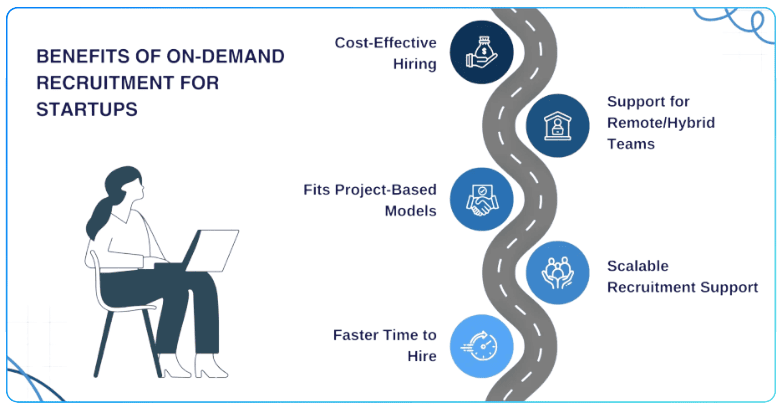
On-demand recruitment is the practice of engaging talent—often highly specialized—for specific periods, projects, or fractional capacities, bypassing the traditional employer-employee relationship. This model prioritizes speed, precision, and utilization.
The Problem: The High Cost of Idleness and Over-Commitment
The traditional hiring model forces businesses to hire full-time talent based on peak hypothetical need. This leads to:
Underutilization: When demand dips, you pay a full salary for idle capacity. This is the Cost of Idleness.
Talent Scarcity: You often can't afford or find specialized domestic talent for short-term, critical projects.
Slow Time-to-Value (TTV): The average U.S. hiring process takes 4-6 weeks, during which market opportunities are missed.
The On-Demand Solution: Elasticity and Optimization
On-demand recruitment, especially when leveraged globally, solves this by allowing businesses to:
Hire for Skill, Not for FTE: Engage a fractional CTO or a specialized Data Scientist for a few months, only paying for the exact hours or deliverables needed.
Scale with Precision: Instantly ramp up customer service capacity during a product launch and scale it back down afterward.
Mitigate Risk: Test new markets or technologies using temporary, specialized talent before making massive permanent investments.
The most profound impact of the on-demand model is the transformation of the business P&L structure. It allows a business to treat its labor costs like utilities—using more when demand is high and less when it's low.
The Strategic Financial Shift:
Revenue-Aligned Labor Cost: By utilizing global on-demand talent, businesses align labor costs directly with revenue fluctuations. If sales spike 25%, you scale your sales support and fulfillment teams 25% instantly. If a campaign fails, you cut back immediately. This financial discipline is impossible with a fixed domestic workforce.
Impact:Maximized Profit Margins because costs never drastically outpace revenue, and capital is not tied up in non-essential capacity.
Unlocking Capital for Innovation: The difference in cost between a fully-burdened domestic FTE and a highly skilled offshore on-demand resource frees up significant capital. This newly available cash can be strategically reinvested into high-growth areas like core technology development, aggressive marketing, or M&A activity.
Impact:Accelerated R&D and Market Penetration, fueling non-linear, sustainable growth.
Project-Based Budget Precision: CFOs gain unparalleled clarity. When a new product feature requires a two-month engagement from a highly specific UX/UI designer, on-demand recruitment provides a fixed, known project cost, eliminating the uncertainty of full-time salary, benefits, and overhead.
The Revenue Angle: This financial elasticity enables a business to be consistently profitable at different revenue levels, transforming labor from a potential liability into an optimized, ROI-driven investment. The greatest constraint on growth for any SME is the localized scarcity of specialized talent. On-demand recruitment breaks down geographical barriers, instantly accessing a global reservoir of skills.
The Strategic Talent Shift:
Sourcing the Global Specialist: Through platforms like BPO Hub, businesses access the world's top talent—whether it's a financial analyst with deep experience in IFRS for a compliance project, or a Python developer skilled in a specific machine learning framework. This talent is often unavailable or prohibitively expensive domestically.
Impact:Elevated Product Quality and Service Delivery, achieved by injecting superior skill precisely where and when it's needed, immediately enhancing competitive standing.
Fractional Leadership and Consultancy: Instead of hiring a full-time, six-figure CSO (Chief Strategy Officer), SMEs can engage a fractional, on-demand CSO for 10 hours a week to guide a specific Q2 initiative. This allows small businesses to benefit from top-tier executive insight that was previously reserved only for large enterprises.
Impact:Improved Decision-Making and Strategic Direction, leading to more successful, focused growth campaigns.
Velocity of Deployment (Time-to-Hire Reduction): The time to source, vet, and deploy on-demand talent is days or weeks, compared to months for traditional hiring. BPO Hub maintains a pre-vetted pool, ready for immediate integration.
Impact:Compressed Project Timelines, ensuring that market opportunities are capitalized on before competitors can react.
The Revenue Angle: By acquiring precise skills instantly, SMEs avoid the performance ceiling imposed by internal skill gaps and accelerate their ability to bring complex, high-value products to market.Growth inherently involves risk: launching a new product, entering a new territory, or adopting an unfamiliar technology stack. On-demand recruitment acts as a highly effective operational shield and testing ground.
The Strategic Operational Shift:
Risk-Free Market Testing: Planning an expansion into a Latin American market? Instead of committing to long-term leases and hiring full domestic teams, an SME can leverage on-demand offshore talent for local sales support, lead generation, and initial customer service. If the market proves viable, they convert the team to a permanent structure. If not, they pivot cleanly.
Impact:Reduced Capital Exposure for Expansion, making market entry safer and more frequent, leading to faster overall growth.
"Try Before You Commit" for Core Roles: BPO Hub often uses the on-demand structure as the ultimate vetting period. A critical role can be filled on a six-month contract, allowing both the company and the talent to ensure a perfect fit before a permanent, costly commitment is made.
Impact:Minimized Cost of Bad Hires, which can save the business tens of thousands in lost productivity and turnover expenses, protecting the profit line.
Built-in Scalability for Peaks and Baselines: The most crucial element of operational agility is the ability to maintain a lean, high-performing "baseline" team while effortlessly scaling for "peak" demands (e.g., Q4 e-commerce rush, annual audits, major software updates). On-demand recruitment ensures you never need to over-staff or under-deliver.
Impact:Consistent Service Quality During Spikes, protecting brand reputation and maximizing revenue capture during the most critical periods.
The Revenue Angle: On-demand models allow businesses to experiment faster, fail cheaper, and scale more aggressively—the fundamental cycle of high-growth companies.
For any business seeking a genuine competitive edge, the decision is clear: growth demands flexibility. On-demand recruitment is not a temporary staffing fix; it is the definitive strategy for building an agile, high-performing, and financially optimized modern workforce. By leveraging BPO Hub’s expertise, you move beyond the limitations of local talent pools and fixed cost structures. You gain the power to access specialized skills instantly, align your labor costs precisely with revenue, and mitigate operational risks associated with aggressive expansion.